
Why LinkedIn Is the Most Valuable Platform Your Company Isn't Using Properly

Updated: Jun 29
LinkedIn now reaches 71.6% of the UK population, hosts 63 million decision-makers globally, and generates 80% of all B2B social media leads — yet most professional services firms treat it as an afterthought. The firms winning on LinkedIn in 2026 aren't the ones with the biggest budgets; they're the ones whose senior people post genuine expertise consistently, because personal profiles generate 8x more engagement than company pages and organic reach still far outpaces every other platform. The single biggest barrier isn't time or strategy — it's that turning what you know into content that builds authority is harder than it looks. That's the gap worth closing.
If you work in professional services — consulting, law, finance, accountancy, HR, recruitment, technology, or any advisory business — you already know LinkedIn exists. You probably have a profile. Your firm may even have a company page someone updates sporadically.
But there's a meaningful gap between being on LinkedIn and using LinkedIn, and in 2026, that gap is costing professional services firms real revenue.
Here's what the data actually shows — and what to do about it.
The Numbers That Should Change Your Strategy
LinkedIn has just crossed 1.3 billion registered members globally, with around 310 million monthly active users. In the UK alone, there are now 49.7 million LinkedIn users — roughly 71.6% of the entire UK population.
But the headline figure isn't the interesting part.
This is:
4 out of 5 LinkedIn members drive business decisions in their organisations
The platform hosts 63 million decision-makers and 10 million C-suite executives
LinkedIn is responsible for 80% of all B2B leads generated via social media — every other platform combined accounts for the remaining 20%
LinkedIn-sourced leads convert at 3x the rate of leads from other social platforms
75% of B2B buyers use social media to inform purchasing decisions; of those, 50% specifically use LinkedIn
For professional services firms, this isn't a social media story. It's a business development story.
Why Professional Services Is a Natural Fit
Other industries fight for attention on LinkedIn. Professional services firms have a structural advantage: you are already selling what LinkedIn rewards.
LinkedIn's 2026 algorithm update made one thing unmistakably clear. It now prioritises authentic expertise over corporate polish. Three out of four decision-makers say thought leadership content is more trustworthy than traditional advertising. Buyers are making purchase decisions based on insights from human experts, not product sheets or promotional campaigns.
That is exactly how professional services firms already work. You win business through trust, reputation, and the quality of your thinking — not through advertising spend. LinkedIn has simply become the platform where that thinking can reach a professional audience at scale.
The firms that understand this are building significant competitive advantages. Those still treating LinkedIn as a glorified CV directory are leaving pipeline on the table.
Five Reasons LinkedIn Works for Professional Services in 2026
1. Your buyers are there, in a buying mindset
When someone opens LinkedIn, they are thinking about their work — their challenges, their decisions, their professional development. Content that speaks to those challenges reaches them at exactly the right moment. This is categorically different from reaching the same person on Instagram or Facebook, where they are in leisure mode and not remotely primed for a professional conversation.
2. Organic reach is still exceptional — but the window is narrowing
LinkedIn's organic reach of 5–10% of followers per post far outpaces Facebook (1–3%) and Instagram feed (3–6%). For professional services firms not yet investing in paid social, this represents significant free distribution to precisely the audience you want. That said, median impressions dropped 47% between mid-2024 and mid-2025 as the platform matured. The firms building audiences now are doing so at a lower cost than those who wait.
3. Thought leadership compounds
A LinkedIn newsletter now achieves 40–50% open rates — the highest of any content format on the platform. A consistent content programme — practical insights, honest commentary on industry challenges, clear points of view — builds what advertising cannot buy: a reputation as the firm that actually understands the problem. Decision-makers remember names they have seen consistently before they ever reach out.
4. Personal profiles outperform company pages — by a significant margin
Posts from individual profiles generate 8 times more engagement than identical content from company pages. Employee networks are on average 12 times larger than the company's own page following. This has a direct strategic implication: your partners, directors, and senior consultants posting their own thinking will deliver more reach and pipeline than any amount of corporate content. The most sophisticated professional services firms in 2026 are investing in this — equipping senior people to build genuine personal brands, not just resharing company announcements.
5. InMail significantly outperforms cold outreach
LinkedIn InMail achieves response rates of 10–25%, compared to 1–5% for cold email. For business development teams, this represents a meaningful channel for targeted outreach to prospects who are already in a professional frame of mind.
How LinkedIn Compares to Other Platforms in 2026
For professional services and B2B organisations, the picture is unambiguous:
Platform | UK Users | Organic B2B Reach | Decision-Maker Concentration | Verdict |
49.7M | High (5–10%) | Very high — 63M decision-makers globally | Primary B2B channel | |
~38M | Very low (1–3%) | Low | Community and paid ads only | |
~33M | Low (3–6% feed) | Low | Visual/consumer brands | |
TikTok | Growing fast | High but unpredictable | Very low | Product discovery; not B2B |
X (Twitter) | ~23M | 0.015% median engagement | Niche | Commentary only |
This isn't a close comparison. For professional services, LinkedIn is the primary platform — not one of several options.
What Good Actually Looks Like in 2026
The firms generating real pipeline from LinkedIn in 2026 are doing a small number of things consistently well:
Individual voices, not corporate broadcasts. Senior professionals posting genuine insights, honest reflections on industry challenges, and clear points of view — not forwarding company press releases. The algorithm trusts individuals; it discounts institutions.
Consistency over volume. Three high-quality posts per week outperforms seven mediocre ones. Firms that publish when they have something worth saying, and go quiet when they do not, build stronger reputations than those maintaining an artificial cadence of filler content.
Carousels and documents, not static images. Document and carousel posts achieve engagement rates 3–6 times higher than static image posts. For firms sharing frameworks, research findings, or practical guides, this format is significantly more effective.
Video, if you can commit to it. Video posts receive five times more engagement than text-only content, and video uploads grew 36% year-on-year in 2025. For firms where senior partners are genuinely articulate on camera, short-form video is the highest-reach format currently available on the platform.
Setting Up LinkedIn Properly for a Professional Services Firm
Whether you are an individual partner or leading a firm-wide LinkedIn strategy, these are the non-negotiables:
For individuals:

Profile photo — A clean, professional headshot. This is your first impression for every prospect who views your profile after seeing your content.
Headline — Not your job title. What do you actually do for clients, and what outcome do they get? "Helping mid-market manufacturers reduce operational risk | Supply Chain Consulting" is more useful than "Partner at XYZ LLP".
About section — Lead with the client problem you solve, not your career history. End with a clear next step.
Featured section — Pin your best piece of content, a relevant case study, or a direct link to your firm's key service. This is prime profile real estate that most people leave blank.
Creator Mode — Enable it. It shifts your profile from connection-centric to content-centric, increasing distribution of everything you publish.
Customise your URL — linkedin.com/in/yourname. It signals attention to detail, and it matters for searchability.
For firms:
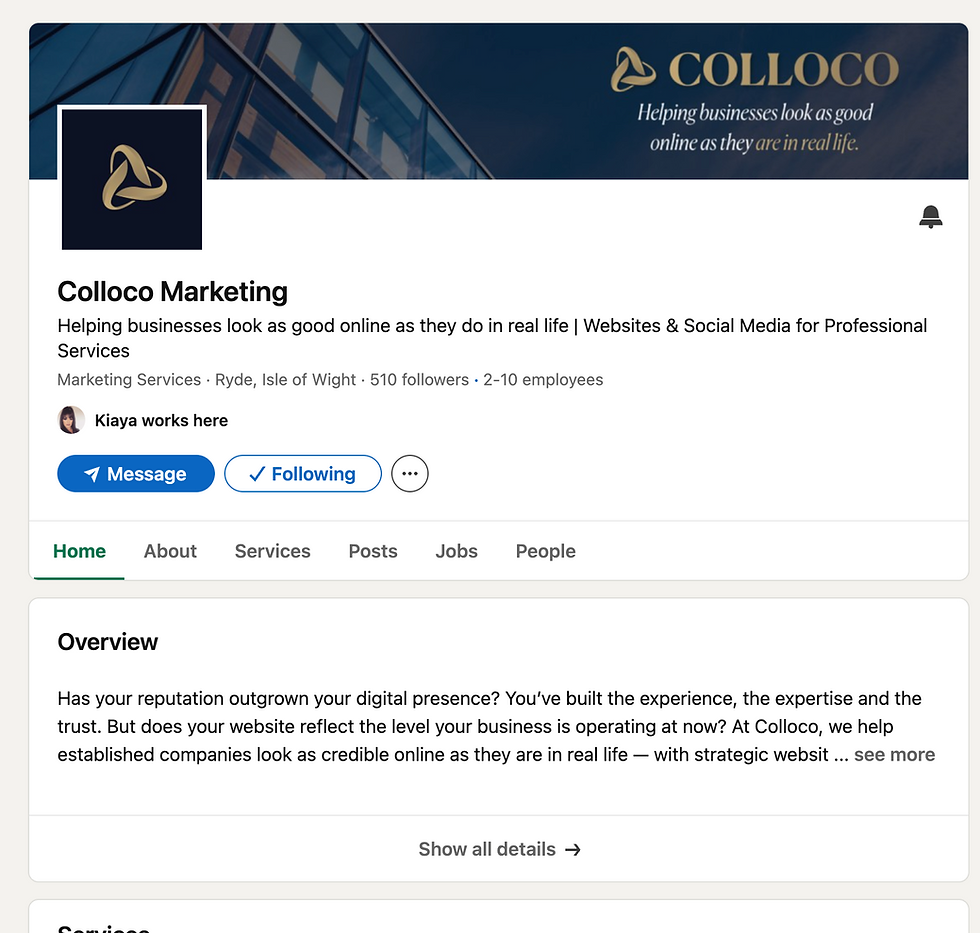
Company page tagline — 120 characters that communicate the outcome you deliver, not a description of your services.
Specialties — These are searchable tags. Use the language your buyers use when they are looking for help, not your internal terminology.
Employee advocacy — Equip your team to share firm content with personal commentary.
Personalised shares achieve dramatically higher engagement than unchanged corporate reposts. Make it easy; provide a framework, not a script.
Post frequency — Firms that post weekly have 5.6 times more followers than those posting monthly, and grow their following 7 times faster.
The Strategic Case, Plainly Stated
LinkedIn is not a social media strategy. For professional services firms, it is a business development infrastructure — one that builds credibility with buyers before they are in the market, stays top of mind while they are considering options, and generates qualified inbound when they are ready to act.
The cost of building that infrastructure is primarily time and consistent intellectual output. Both are things professional services firms already have.
The obstacle, almost always, is not willingness. It's this: most professionals find it genuinely difficult to articulate their own expertise in writing. The thinking is there. The experience is there. The knowledge that would build real authority is there. It just doesn't translate easily to a blank page.
That's exactly the problem the Visibility Interview™ is designed to solve.

The Visibility Interview™ — For Companies Who Are Ready to Be Seen
Most professional services firms don't have a quality problem. They have a perception problem. Their online presence doesn't reflect the standard of the work they actually do.
The Visibility Interview™ is a 50-minute strategic conversation that fixes that.
We draw out your expertise, your positioning, and your point of view — and turn it into 10–15 LinkedIn posts written in your voice, ready to publish.
No blank pages. No hours second-guessing what to write. No content that sounds like it could have come from anyone.
It's built for:
Founders and directors who are excellent at what they do but find it hard to express online
CEOs who want their senior team showing up confidently and consistently on LinkedIn
Firms that want high-quality content without making it someone's second job
One interview. A month or more of credible, authoritative content. A LinkedIn presence that finally reflects the firm you've built.
Sophia Brading is the founder of Colloco Marketing, a UK-based agency specialising in strategic website design and social media for professional services firms. Book a strategy call to talk about your LinkedIn presence.


Comments